Monday, 28 February 2011

Dropsaw

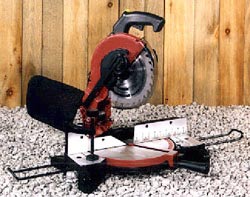
A power miter saw, also known as a chop saw or drop saw, is a power tool used to make a quick, accurate crosscut in a workpiece. Common uses include framing operations and the cutting of molding. Most miter saws are relatively small and portable, with common blade sizes ranging from eight to 12 inches.
The miter saw makes cuts by pulling a spinning circular saw blade down onto a workpiece in a short, controlled motion. The workpiece is typically held against a fence, which provides a precise cutting angle between the blade and the longest workpiece edge. In standard position, this angle is fixed at 90°.
A primary distinguishing feature of the miter saw is the miter index that allows the angle of the blade to be changed relative to the fence. While most miter saws enable precise one-degree incremental changes to the miter index, many also provide "stops" that allow the miter index to be quickly set to common angles (such as 15°, 30°, 45°, or 75°).
File:Miter saw.jpg

Jigsaw

A jigsaw is a tool used for cutting arbitrary curves, such as stenciled designs or other custom shapes, into a piece of wood, metal, or other material. It can be used in a more artistic fashion than other saws, which typically cut in straight lines only. In this way, it is similar to the rasp and the chisel. Although a jigsaw can be used to cut arbitrary patterns, making a straight cut freehand is difficult even with a guide.

router

A router is a woodworking tool used to rout out (hollow out) an area in the face of a piece of wood. It was a tool particularly used by pattern makers and staircase makers and consisted of a broad-based wooden hand plane with a narrow blade projecting well beyond its base plate

Planer

A plane is a tool for shaping wood. Planes are used to flatten, reduce the thickness of, and impart a smooth surface to a rough piece of lumber or timber. Planing is used to produce horizontal, vertical, or inclined flat surfaces on workpieces usually too large for shaping. Special types of planes are designed to cut joints or decorative mouldings.
Hand planes are generally the combination of a cutting edge, such as a sharpened metal plate, attached to a firm body, that when moved over a wood surface, take up relatively uniform shavings, by nature of the body riding on the 'high spots' in the wood, and also by providing a relatively constant angle to the cutting edge, render the planed surface very smooth. A cutter which extends below the bottom surface, or sole, of the plane slices off shavings of wood. A large, flat sole on a plane guides the cutter to remove only the highest parts of an imperfect surface, until, after several passes, the surface is flat and smooth.

Drill

A drill or drill motor is a tool fitted with a cutting tool attachment or driving tool attachment, usually a drill bit or driver bit, used for drilling holes in various materials or fastening various materials together with the use of fasteners. The attachment is gripped by a chuck at one end of the drill and rotated while pressed against the target material. The tip, and sometimes edges, of the cutting tool does the work of cutting into the target material. This may be slicing off thin shavings (twist drills or auger bits), grinding off small particles (oil drilling), crushing and removing pieces of the workpiece (SDS masonry drill), countersinking, counterboring, or other operations.
Drills are commonly used in woodworking, metalworking, construction and do-it-yourself projects. Specially designed drills are also used in medicine, space missions and other applications.

Circular Saw

The circular saw is a metal disc or blade sometimes with saw teeth on the edge as well as the machine that causes the disk to spin. It is a tool for cutting wood or other materials and may be hand-held or table-mounted. It can also be used to make narrow slots (dados). Most of these saws are designed with a blade to cut wood but may also be equipped with a blade designed to cut masonry, plastic, or metal. There are also purpose-made circular saws specially designed for particular materials. While today circular saws are almost exclusively powered by electricity, larger ones, such as those in "saw mills", were traditionally powered by water turning a large wheel.
File:Miter saw.jpg

biscuit cutter

A biscuit joiner or sometimes plate joiner is a woodworking tool used to join two pieces of wood together. A biscuit joiner uses a small 100mm (4") diameter tungsten carbide tipped circular saw blade to cut a crescent shaped hole (called the mouth) in the opposite edges of two pieces of wood or wood composite panels. An oval-shaped, highly-dried and compressed wooden biscuit (usually ) is covered with glue, or glue is applied in the slot. The biscuit is immediately placed in the slot, and the two boards are clamped together. The wet glue expands the biscuit, further improving a bond that is often stronger than the wood itself.

February 28

started in building thats preconstructed, and talked about the diferent types of bracings and materials used in the building. . . . . after first break we put in to pairs and reasearched the safety parts on power tools, how you use them. . . . .played touch for an hour while other class mates were getting there tools. . . . .after we obtained our tools we sharped our chizeals. . . . .

February 23

start new joint project and half way complete. . . . walked around campas identifing hazards. . . . . soonafter went to classroom and put the hazards into catagories of (i) isolate, (m) minimize, (e) eliminate. . .  . .

Monday, 21 February 2011

February 22nd

morning started with filling out our bloggs. . . .

continued and completed joints in practicle lessons. . . .

started and completed building research in i.t room. . . . .

Building Research

1. Describe three building categories for building licencing?
·         Building category 1. . . . Single household dwellings with low- or medium-risk envelope design.
·         Building category 2. . . . Single household dwellings with high-risk envelope design, or other buildings with a building height* less than 10 m.
·         Building category 3. . . . All buildings 10 m or greater in building height*, except single household dwellings.
2. List the seven licencing classes.
·         Site
·         Design
·         Bricklaying and block laying
·         Carpentry
·         External Plastering
·         Foundation
·         Roofing
3. When was the LBP scheme introduced and from what date do builders have to be licenced?  
·         From April 2010, people registered to carry out building work under other statutory registration systems, are automatically treated as licensed under the corresponding class in the LBP scheme for the purpose of carrying out restricted building work.
·         you will need to be licensed if you wish to carry out or supervise restricted building work from 1 March 2012.
4. The is the difference between the building act, building regulation and the building code?
·         In New Zealand, the building of houses and other buildings is controlled by the Building Act 2004. It applies to the construction of new buildings as well as the alteration and demolition of existing buildings.

·         The Building Act 2004 has repealed the Building Act 1991 and introduces a number of changes to the law governing building work. These changes are introduced in stages. Some have already taken effect, but others will be implemented over the next few years

·         Building regulations form an important part of New Zealand’s building controls.

·         Building regulations are made under and in accordance with the Building Act 2004 (the Act). The type of regulations that can be made, including the process that must be followed when creating new regulations are given in Sections 400-415 of the Act.

·         The Building Regulations 1992, and subsequent amendments, were made under the Building Act 1991 but are now treated as if they were regulations made under the Act. However, the majority of the 1992 Regulations were revoked on 31 March 2005 by the Building (Forms) Regulations 2004. The only part of the 1992 Regulations continuing in force is Schedule 1 containing the Building Code.

·         All new building work in New Zealand must comply with the Building Code. It is a performance-based code, which means it states how a building and its components must perform as opposed to describing how the building must be designed and constructed

5.  In relation to weather tightness, what are the 4 D’s?
·         Deflection – keeping water away from potential entry points
·         Drainage – providing means of removing water that does enter.
·         Drying – allowing any remaining moisture to be removed by ventilation or diffusion.
·         Durability – providing materials with appropriate durability.
 

february 21st

today consist of role playing a scenerio given to us from the lecturers. . . . .the team i was in acted out a fire at the work place. . . . .

after first break we constructed a halving joint and a stopped halving joint. . . .

we finished of or day in the library. . . . we went there for a induction. . . .and how to use the librarys numbering system. . .

february 16th

did safety exercises and learnt about (osh)

contrusted a dub-tail. . . .first practial lesson

february 15th

today started in the computer roooms. . . .to abtain logins.

created a bloggers account. .